Last June, Friends began a new Writer In Residence program designed to support writers who are diving deep into stories of the waterfront, past, present and future. Through site-specific work created during these residencies, the writers can bring to light stories, histories and experiences that illuminate the richness of our shoreline and what it means to our city.
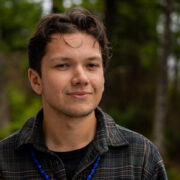 Our inaugural Writer In Residence is Owen Oliver, whose term extends until May 2027. Having recently graduated with his MFA in Creative Writing from the Institute of American Indian Arts, he is working on a novel that connects Seattle’s history to themes of loss and grief through land, family and gentrification. Owen will be writing a monthly column Tidings that will show up here in our newsletter and on our blog, piecing together unique non-fiction and fictionalized stories centering on the waterfront. You can learn more about Owen and find his other work at owenloliver.com.
Recently, someone at a party introduced me to a person who said they were from Seattle. We are a rare bunch these days. I feel pretty ambivalent about borders except when it comes to where you lay your claim. If you say you are from Seattle, but you are actually from Woodinville, Newcastle, Des Moines or any town that isn’t Seattle then you are just embellishing your locality. It happened a lot in college. Less so now. But I guess I take a lot of pride in being someone who is from Seattle and has lived here for the better part of my life. We could go back some generations, but that is for a different time.
The guy and I clicked right away. We grew up in nearby neighborhoods. We reminisced about the 2014 Seahawks championship and the subsequent loss the next year. We both shared our coveted coffee spots that have resisted gentrification. I even referenced our old resident clown J.P. Patches and he didn’t bat an eye. Eventually, he asked me what I do for work and I shared that I was just coming off working on the Seattle Waterfront. Specifically the new Seattle Aquarium. He recognized it and loved being on the Salish Steps for the World Cup. He loved the energy and how people were packed in like sardines. A cheeky nod toward the historic fish packing plants along the waterfront. Or so I thought. I was expressing how nice it was that the viaduct was taken down and that now we have this beautiful and expansive waterfront. But he stopped me and said, “Viaduct” What do you mean” “Oh, the viaduct that was taken down in 2019. I am so glad it’s gone,” I said. He follow up with, “What do you mean? I don’t know the viaduct is.” He swore that he didn’t know what the viaduct was. I even pulled up a picture and it just washed over him. I didn’t know if this was an elaborate prank or if there were hidden cameras. I had never felt so stupefied. I looked around to see if anyone else was hearing this. For some reason, I had this notion that everyone born in Seattle had the viaduct burned into their minds. Like a litmus test tunneled deep in our brain so even at the drop of a hat, they would share their opinion on the viaduct’s removal. I didn’t event know if it was possible to meet who didn’t remember the viaduct.
The Alaskan Way Viaduct was constructed over a decade and completed in 1959. It morphed State Route 99, running from Fife to Everett. It was built to elevate Seattle as a modern city and decongest traffic. Notably, it was a double-deck freeway that gave expansive views of Puget Sound and the Olympic Mountains. However, these views were only available if you were going north, hence driving on the top level. If you were driving south, you were trapped between the legs of a concrete millipede. Once called the ugliest walk in Seattle, the underside of the viaduct was dark, dank and dystopian. If the waterfront today sings and dances, the viaduct gurgled and spat.
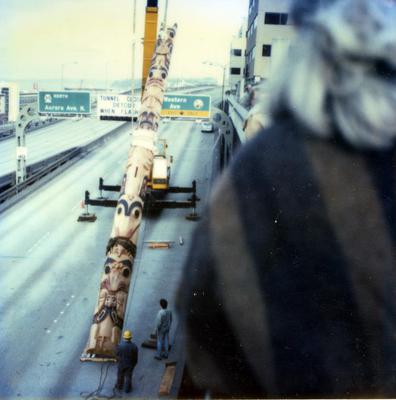
Courtesy of the Seattle Municipal Archives, #175592
Instead of telling my new friend about the blight of the Alaskan Way Viaduct, I simply retold a story that my father told me a long time ago. It was about the time that the Pike Place totem poles were being installed at Victor Steinbrueck Park and how the viaduct was closed off to offload two towering poles via a crane. Then later how a similar effort was made in our backyard in Wallingford when my dad shipped a totem pole to Jackson Hole, Wyoming. And in those two acts, art prevailed over cars and art interrupted someone’s daily commute and something out of the ordinary happened. And that something was only clear if you were paying attention. He followed up with a dozen questions but the reality of the viaduct wasn’t questioned. It built place in my story. It was a defining feature. There wasn’t room to say that it didn’t happened.
This all makes me wonder when the discourse around the viaduct will evaporate? What other stories about Seattle’s’s waterfront do we no longer carry? There are a quarter of a million entries for the Alaskan Way Viaduct on Google. Yet some information is just not received or shared. I think about my friend and where our paths diverged. How do people remember boring and bland things? How are they easily forgotten? When I’m on the waterfront, I think about the thousands of years before contact and the mundane conversations that happened on these shores while clamming, watching a sunset or the person complaining that there are too many canoes and not enough parking.